

Mutual fund investors sometimes receive notifications that their fund house is merging with another asset management company (AMC), or that one mutual fund scheme is being merged into another. Such announcements can create confusion about the safety of investments, existing units, NAV, returns and tax liabilities.
For example, suppose you have invested ₹2 lakh in an equity mutual fund, and the fund house announces that it is merging with another mutual fund company. Will your investment disappear? Will you receive new units? Will you have to pay capital gains tax? Can you withdraw your money without an exit load?
The answer depends on the type of merger.
A merger between two fund houses is different from the consolidation of two mutual fund schemes. In most approved transactions, investors’ holdings continue under the applicable arrangements, but the investment strategy, fund management, scheme name or administrative details may change.
This article explains what happens to mutual fund investments when a fund house merges in India, including changes to units, NAV, taxation, SIPs, exit options and investor rights.
Understand the Difference Between a Fund House Merger and a Mutual Fund Scheme Merger
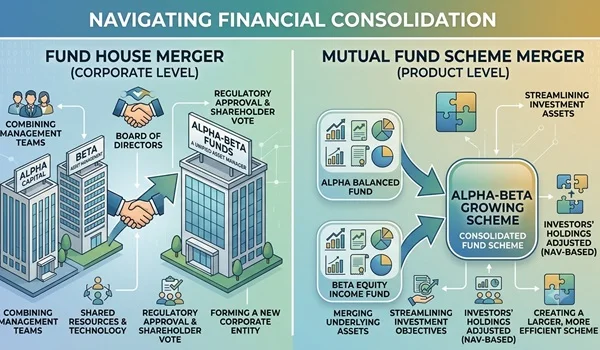
Before understanding the impact on your investment, it is important to distinguish between two types of mergers.
Fund house or AMC merger
An Asset Management Company (AMC) manages mutual fund schemes on behalf of the mutual fund.
When two AMCs merge or one AMC takes over another, the ownership or management of the fund house may change.
For example, one AMC may acquire another AMC and take responsibility for managing its mutual fund schemes.
In this situation:
- The AMC’s ownership or management may change.
- The fund manager may change.
- The brand name may be replaced.
- Investor servicing arrangements may change.
- Existing schemes may continue under the new management.
- Some schemes may subsequently be merged or consolidated.
An AMC merger does not automatically mean that every mutual fund scheme managed by it will also merge.
Mutual fund scheme merger
A scheme merger happens when one mutual fund scheme is combined with another scheme.
For example, a fund house may merge Scheme A into Scheme B because their investment objectives, categories or portfolios are similar.
In this situation, investors in the merging scheme generally receive units of the surviving scheme according to the approved exchange ratio.
The original scheme may stop operating after the merger becomes effective.
What Happens to Your Existing Mutual Fund Units?
If your mutual fund scheme is merged into another scheme, you generally receive replacement units in the surviving scheme.
The number of units is calculated using the approved allocation or exchange ratio, which is generally based on the relative NAVs of the schemes on the specified valuation date.
You should not assume that the number of units will remain unchanged.
Example of a mutual fund scheme merger
Suppose you hold:
- Investment value: ₹1,00,000.
- Existing scheme NAV: ₹50.
- Units held: 2,000.
Now suppose the scheme merges into another fund with an NAV of ₹100.
Assuming the merger takes place at equivalent NAV value, the new units would be:
₹1,00,000 ÷ ₹100 = 1,000 units.
| Particulars | Before merger | After merger |
| Scheme | Scheme A | Scheme B |
| NAV | ₹50 | ₹100 |
| Number of units | 2,000 | 1,000 |
| Investment value | ₹1,00,000 | ₹1,00,000 |
Illustrative result: The investment value remains ₹1 lakh at the time of the merger.
The reduction in the number of units does not mean that you have lost money. The NAV per unit is also different.
Actual allotment depends on the exchange ratio and valuation specified in the official merger communication. Subsequent market movements can increase or decrease the investment value.
Does Your Mutual Fund NAV Change After a Merger?
Yes, the NAV of the surviving scheme may be different from the NAV of the original scheme.
However, a change in NAV does not automatically indicate a profit or loss.
NAV represents the per-unit value of a mutual fund scheme. When units are exchanged during consolidation, the number of replacement units is calculated according to the approved allocation method.
For example:
- Original scheme NAV: ₹25.
- Surviving scheme NAV: ₹50.
- Original investment: ₹50,000.
- Original units: 2,000.
- Replacement units at equivalent value: 1,000.
The investment value remains ₹50,000 at the time of the exchange, assuming no valuation adjustment.
After the merger, the surviving scheme’s NAV will move according to the market value of its portfolio and other applicable factors.
You should therefore compare the total investment value rather than looking only at the NAV or number of units.
What Happens to Your Mutual Fund Investment’s Portfolio?
One of the most important changes after a scheme merger may be the underlying investment portfolio.
The surviving scheme may have a different combination of shares, bonds, money market instruments or other permitted investments.
For example, suppose a mutual fund merges two equity schemes:
- Scheme A mainly invests in large-cap companies.
- Scheme B invests across large-cap, mid-cap and small-cap companies.
After consolidation, the surviving scheme may have a different investment allocation and risk profile.
Similarly, a debt scheme merger may change the portfolio’s duration, credit quality or exposure to particular issuers.
Before accepting the merger, review:
- Investment objective.
- Asset allocation.
- Top holdings.
- Sector exposure.
- Credit quality, for debt schemes.
- Riskometer.
- Expense ratio.
- Benchmark.
- Fund manager and investment strategy.
A scheme merger does not guarantee better performance. The surviving scheme may perform differently from the original scheme.
Can You Withdraw Your Mutual Fund Investment Without an Exit Load?
Yes, SEBI provides an exit option to investors in specified merger and consolidation situations.
Under SEBI’s Mutual Funds Master Circular dated 20 March 2026, mutual fund scheme consolidation is treated as a change in the fundamental attributes of the concerned schemes, subject to the applicable regulatory requirements.
The merger proposal must be approved by the AMC’s board and trustees and filed with SEBI.
Investors are generally provided an opportunity to exit at the prevailing NAV without an exit load.
For a change in control of an AMC that results in consolidation or merger of schemes, the applicable exit window must be at least 30 calendar days from the date of communication.
The applicable rules also distinguish ordinary changes in AMC control from changes resulting in scheme consolidation.
What should investors do during the exit window?
If you do not want to continue with the surviving scheme, you can consider redeeming your units during the announced exit period.
Before submitting a redemption request:
- Read the merger notification.
- Check the exit window’s opening and closing dates.
- Confirm the applicable NAV and redemption procedure.
- Check whether any lock-in restriction applies.
- Understand the tax consequences.
- Compare alternative investment options before switching.
Important: An exit without an exit load does not necessarily mean a tax-free redemption. Capital gains tax may still apply.
What Are the Tax Implications When a Mutual Fund Scheme Merges?
Tax treatment is an important consideration because investors may assume that receiving units of another scheme automatically creates a taxable transaction.
Under the Income-tax Act, 2025, which came into force on 1 April 2026, qualifying mutual fund scheme consolidations receive tax-neutral treatment under Section 70(1)(zj).
The exemption applies when the consolidation involves:
- Two or more schemes of equity-oriented mutual funds; or
- Two or more schemes of funds other than equity-oriented funds.
The transaction must satisfy the applicable statutory and SEBI regulatory conditions.
Does the cost of acquisition change?
Generally, no. Under Section 73 of the Income-tax Act, 2025, the cost of acquisition of the replacement units is linked to the original cost of the units held in the consolidating scheme.
The holding period of the original investment is also relevant when calculating the holding period of the replacement units.
This means the merger itself does not ordinarily reset your original investment history for a qualifying tax-neutral consolidation.
Example
Suppose you invested ₹1 lakh in an eligible equity mutual fund scheme two years ago.
The scheme is now merged into another qualifying equity-oriented scheme.
You receive replacement units under the approved merger arrangement.
In a qualifying tax-neutral merger:
- The allotment itself is not treated as a taxable sale.
- The original acquisition cost is carried forward.
- The original holding period is included.
You generally calculate capital gains when you eventually sell the replacement units, applying the tax rules relevant to that redemption.
What if you exit during the merger window?
If you redeem your investment instead of accepting the replacement units, the redemption may create a taxable capital gain or loss.
The applicable tax treatment depends on the type of mutual fund, acquisition date, holding period and prevailing tax provisions.
Therefore, an exit without an exit load should not be confused with an exemption from capital gains tax.
What Happens to Your SIP, STP and SWP After a Fund House Merger?
Investors using Systematic Investment Plans (SIPs), Systematic Transfer Plans (STPs) or Systematic Withdrawal Plans (SWPs) should check how the merger affects their existing instructions.
The treatment depends on the particular merger and the AMC’s instructions.
SIP after a scheme merger
If your SIP is registered in a scheme that is being merged, future instalments may be redirected to the surviving scheme, discontinued or require fresh registration, depending on the arrangement.
Check the AMC’s official communication before assuming that the existing SIP will continue unchanged.
STP after a scheme merger
If the source or target scheme of an STP is affected, the AMC may modify the transaction arrangement or transfer the registration to the surviving scheme.
Confirm the treatment of both the source and target schemes.
SWP after a scheme merger
If you use an SWP to receive regular withdrawals, check whether the existing instructions will continue under the surviving scheme.
Also verify the revised unit balance, NAV and withdrawal dates.
Practical tip: Do not rely solely on an app notification showing that your scheme has changed. Verify the updated systematic transaction instructions with the AMC or registrar.
What Happens to Your Growth and IDCW Options?
Mutual funds may offer different investment options, including:
- Growth option.
- Income Distribution cum Capital Withdrawal (IDCW) option.
The treatment of these options depends on the merger structure and the surviving scheme’s available options.
If the corresponding option continues in the surviving scheme, the AMC’s merger communication will explain how the units are allotted.
If the options are changed or reorganised, review the applicable tax and investment implications before making a decision.
Remember that IDCW distributions are not guaranteed income. They are subject to the scheme’s distributable surplus and applicable policies, and may reduce the scheme’s NAV.
What Should You Check Before Accepting a Mutual Fund Merger?
A merger can change the investment characteristics of your mutual fund. Therefore, do not make your decision solely because the surviving scheme belongs to a well-known fund house.
Review the following information:
| Factor | What to examine |
| Investment objective | Whether it still matches your financial goal |
| Fund category | Whether the surviving scheme has a similar investment mandate |
| Asset allocation | Whether equity, debt and other exposures have changed |
| Riskometer | Whether the overall risk level is suitable |
| Expense ratio | Whether the ongoing cost has changed |
| Fund manager | Whether the investment team has changed |
| Portfolio holdings | Whether the underlying investments are different |
| Performance | How the surviving scheme has performed against its benchmark |
| Exit window | Last date to redeem without exit load |
| Tax impact | Whether redemption or switching creates a taxable event |
You should also read the revised Scheme Information Document (SID), the official merger notice and the latest portfolio disclosure.
What Should You Do If Your Mutual Fund Investment Is Not Updated After a Merger?
Sometimes, investors may not immediately see their replacement units in their investment app or account statement.
This may happen because of processing delays, registrar updates or differences in reporting systems.
If your investment is not updated:
- Check the effective merger date.
- Read the AMC’s allotment and unit-credit announcement.
- Download your latest consolidated account statement.
- Contact the AMC’s investor service department.
- Contact the relevant Registrar and Transfer Agent (RTA), such as CAMS or KFin Technologies, where applicable.
- Keep your original folio number, PAN and transaction records available.
If the issue remains unresolved, you can first raise a formal complaint with the mutual fund. You may subsequently use SEBI’s SCORES grievance-redressal platform, subject to its applicable process.
Do not share your account password, OTP or sensitive authentication details with anyone claiming to resolve a merger-related issue.
Frequently Asked Questions (FAQs)
Will I lose money if my mutual fund house merges with another fund house?
Not automatically. A fund house merger does not itself mean that your investment value disappears. The impact depends on whether only the AMC changes or the mutual fund schemes are also consolidated. Market movements can still affect the value of your investment.
Will I receive new units after a mutual fund scheme merger?
Generally, yes. Investors in a merging scheme receive replacement units in the surviving scheme according to the approved exchange ratio and valuation method.
Is a mutual fund scheme merger taxable in India?
A qualifying consolidation of two or more equity-oriented schemes or two or more schemes other than equity-oriented funds is generally tax-neutral under Section 70(1)(zj) of the Income-tax Act, 2025, subject to statutory conditions.
Can I withdraw my investment during a mutual fund merger?
Yes, investors are generally provided an exit opportunity under the applicable SEBI rules. For a change in AMC control resulting in scheme consolidation or merger, the exit window must be at least 30 calendar days. Check the specific notice for dates and conditions.
Will my SIP stop after a mutual fund merger?
Not necessarily. Depending on the merger arrangement, your SIP may continue in the surviving scheme, be redirected or require a new registration. Check the AMC’s official communication.
Will the NAV of my mutual fund remain the same after a merger?
Not necessarily. The surviving scheme may have a different NAV. The number of replacement units is calculated according to the approved allocation ratio, so a different NAV does not automatically mean a change in investment value.
Does a fund house merger change the fund manager?
It may. The new AMC may retain the existing fund management team or appoint a different manager. Investors should check the latest scheme documents and fund manager disclosures.
Should I redeem my mutual fund investment whenever a merger is announced?
Not automatically. Review the surviving scheme’s investment objective, portfolio, risk, expenses and performance before deciding. A merger alone is not necessarily a reason to redeem.
Conclusion
When a mutual fund house merges with another fund house, your investment does not automatically disappear. However, the impact depends on whether the transaction involves only a change in AMC ownership or an actual merger of mutual fund schemes.
In a qualifying scheme merger, investors generally receive replacement units based on the approved exchange ratio. The investment’s original acquisition cost and holding period are generally carried forward for tax purposes when the statutory conditions are met.
SEBI also provides an exit opportunity in specified merger situations, allowing eligible investors to redeem at the prevailing NAV without an exit load during the prescribed period.
Before making a decision, carefully examine the merger notice, surviving scheme’s investment objective, portfolio, expenses and tax implications. Your decision should depend on whether the resulting investment continues to suit your financial goals and risk tolerance.
Disclaimer: This article is for educational purposes only and does not constitute investment, financial or tax advice. Mutual fund investments are subject to market risks. Read the relevant scheme documents and consult a qualified financial or tax adviser before making investment decisions.