

Companies often collect personal documents such as Aadhaar cards, PAN cards, passports, bank statements and photographs for employment, loan applications, property transactions and customer verification. However, problems arise when a company uses these documents for purposes that were never explained or authorised.
For example, a company may use your PAN card to open an account, share your identity documents with an unrelated third party or retain your documents after you withdraw your application.
Using personal documents without proper authority can raise privacy, data protection and identity theft concerns. Indian law provides different remedies depending on the type of information, how it was used and whether the company committed any offence.
Can a Company Use Your Personal Documents Without Consent?
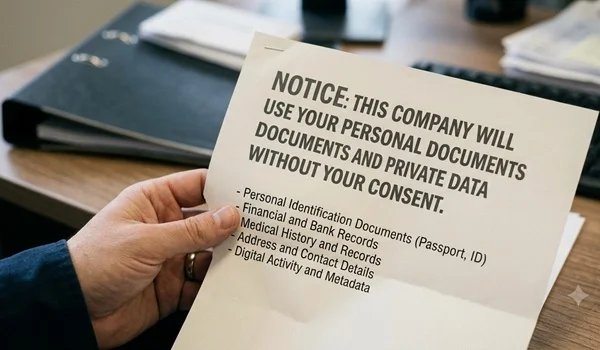
A company cannot assume that receiving your documents gives it unlimited permission to use them.
Personal documents contain information that can identify an individual, including:
- Aadhaar number and identity details.
- PAN number and financial information.
- Passport and driving licence details.
- Bank account information.
- Photographs and signatures.
- Address and contact details.
- Employment and salary records.
A company should use personal information for a lawful and properly explained purpose. It should not automatically reuse documents for unrelated activities simply because you submitted them for verification.
However, consent is not the only possible legal basis for processing information. Certain uses may be permitted or required under applicable laws, regulatory obligations or other recognised legal grounds.
For example, a bank may need identity documents to complete legally required KYC verification. This does not give it unrestricted permission to share or reuse those documents for unrelated purposes.
Which Indian Laws Protect Your Personal Documents?
Several Indian laws and regulations may apply when a company misuses personal documents.
Digital Personal Data Protection Act, 2023
The Digital Personal Data Protection (DPDP) Act, 2023 establishes a framework for processing digital personal data in India.
It addresses matters such as:
- Lawful processing of personal data.
- Consent and permitted non-consensual processing.
- Obligations of companies handling personal information.
- Withdrawal of consent.
- Data security.
- Individual rights concerning personal data.
- Complaints and enforcement.
Important implementation update: The Act has a phased commencement schedule. As of 31 October 2026, its main provisions governing consent, processing obligations and individual data rights are scheduled to come into force 18 months after the November 2025 notification, in May 2027. Therefore, these substantive rights should not be presented as already fully enforceable in October 2026.
Information Technology Act, 2000
The Information Technology Act contains provisions relevant to unauthorised use of computer resources and personal information.
Section 43A and the Information Technology (Reasonable Security Practices and Procedures and Sensitive Personal Data or Information) Rules, 2011 have been important in regulating certain sensitive personal information handled by companies.
Section 66C deals with identity theft, including fraudulent use of another person’s electronic signature, password or other unique identification feature.
Section 72A addresses disclosure of personal information in breach of a lawful contract, subject to its statutory requirements.
The applicable provisions depend on the nature of the misuse and the facts of the case.
Aadhaar Act, 2016
If a company misuses your Aadhaar information or performs unauthorised Aadhaar authentication, the Aadhaar Act and UIDAI regulations may become relevant.
You can also report Aadhaar-related concerns directly to UIDAI.
What Should You Do If a Company Uses Your Documents Without Permission?
If you discover that a company has used your personal documents for an unauthorised purpose, take the following steps.
Step 1: Identify How Your Documents Were Misused
First, establish exactly what happened.
For example:
- Your PAN card was used to open an account without your knowledge.
- Your Aadhaar details were used for an unauthorised verification.
- Your bank statement was shared with another company.
- Your photograph or signature was used in a different application.
- Your documents were retained after you withdrew your application.
- Your identity documents were used to obtain a loan or financial service.
Identify the company, date, document involved and purpose of the suspected misuse.
Step 2: Collect Supporting Evidence
Preserve all available evidence before contacting the company.
Useful evidence includes:
- Emails and WhatsApp messages.
- Copies of submitted documents.
- Application forms.
- Consent forms and privacy notices.
- Screenshots of unauthorised transactions.
- Bank statements.
- Loan or account notifications.
- Communication from the company.
- Details of any third party that received your documents.
Do not delete messages or alter original evidence.
Step 3: Send a Written Complaint to the Company
Contact the company’s grievance officer, customer support department or data protection contact, where available.
Clearly explain that your personal documents appear to have been used beyond the purpose for which they were submitted.
Ask the company to:
- Explain why your documents were used.
- Identify the information collected and its purpose.
- Explain whether the information was shared with third parties.
- Identify the recipients, where legally disclosable.
- Stop any unauthorised use.
- Correct inaccurate information.
- Delete information that it has no legal basis to retain.
- Confirm the action taken.
Keep the complaint acknowledgement and the company’s response.
Step 4: Withdraw Consent Where Applicable
If you previously permitted a company to use your personal information, you may withdraw that consent where consent is the applicable legal basis.
Under the DPDP Act, Section 6 provides for withdrawal of consent, and the company must provide a reasonably accessible withdrawal mechanism once the relevant provisions become effective.
However, withdrawing consent does not automatically require a company to delete every document. Information may need to be retained under another applicable law, regulatory requirement or lawful basis.
Where Can You File a Complaint Against a Company?
The appropriate complaint authority depends on the type of document misuse.
| Type of misuse | Possible complaint authority |
| Aadhaar misuse | UIDAI |
| Online identity theft | National Cyber Crime Reporting Portal or police |
| Unauthorised financial account | Concerned bank or financial institution |
| PAN misuse | Income Tax Department, where relevant |
| Sensitive personal data misuse | Appropriate legal or regulatory forum |
| Banking KYC misuse | Bank’s grievance mechanism and RBI complaint process, where eligible |
| Fraudulent loan application | Lender and police or cybercrime authorities |
National Cyber Crime Reporting Portal
If your documents have been used for online identity theft, fraudulent accounts or financial fraud, you can file a complaint through the government’s cybercrime portal.
Official website: https://cybercrime.gov.in/
The portal allows individuals to report cybercrime incidents and submit supporting evidence. Complaints are handled by the relevant police authorities.
If money has been fraudulently taken from your bank account, contact your bank immediately and report the financial cybercrime through the appropriate channels.
UIDAI Complaint for Aadhaar Misuse
If you suspect Aadhaar-related misuse:
- Check your Aadhaar authentication history.
- Lock your biometrics if suspicious biometric activity is detected.
- Contact UIDAI.
- Report the issue through its grievance channels.
UIDAI provides assistance through its official website and helpline 1947.
What If a Company Uses Your PAN or Aadhaar to Open an Account?
This situation requires immediate attention because unauthorised account creation may expose you to financial fraud, tax-related complications or identity misuse.
Take these steps:
For PAN misuse:
- Check your credit reports for unfamiliar loan accounts or enquiries.
- Review tax-related information available through official Income Tax Department services.
- Contact the financial institution associated with the suspicious account.
- Report suspected identity fraud to the police or cybercrime portal.
For Aadhaar misuse:
- Review authentication history through UIDAI.
- Lock biometrics if you suspect biometric misuse.
- Contact the relevant authentication service provider.
- Report suspicious activity to UIDAI.
Remember that simply sharing an Aadhaar or PAN photocopy does not automatically prove that someone has opened an account using it. Verify the transaction or account before making allegations.
Can You Claim Compensation for Unauthorised Use of Personal Documents?
Compensation may be available when the company’s conduct violates an applicable legal obligation and the required conditions for a claim are established.
Under Section 43A of the Information Technology Act, 2000, compensation may be relevant where a body corporate handling sensitive personal data is negligent in maintaining reasonable security practices and procedures, resulting in wrongful loss or wrongful gain.
Section 72A may also apply to certain disclosures of personal information in breach of a lawful contract.
However, not every unauthorised use automatically results in compensation. The applicable legal provision, negligence, contractual obligations and evidence must be examined.
The DPDP Act also provides a framework for individual rights and enforcement, but its main substantive provisions are scheduled for commencement in May 2027.
What Precautions Should You Take Before Sharing Personal Documents?
You can reduce the risk of misuse by following these precautions:
- Share only documents genuinely required for the service.
- Ask why each document is being collected.
- Use a masked Aadhaar copy wherever accepted.
- Write the recipient’s name and purpose on document photocopies.
- Avoid sharing identity documents through unknown links.
- Never share OTPs, passwords or banking PINs.
- Check the company’s privacy policy.
- Avoid sending unprotected documents to unknown email addresses.
- Keep records of documents submitted.
- Ask how long the company will retain your information.
For Aadhaar-related verification, use authorised channels and check whether the organisation is permitted to perform the relevant authentication.
Frequently Asked Questions (FAQs)
Can I file a police complaint if a company uses my Aadhaar without permission?
Yes, if the circumstances indicate identity theft, fraud or another criminal offence. You can also report Aadhaar-related misuse to UIDAI through its grievance channels.
Can a company keep my documents after I cancel my application?
It depends on the applicable legal and regulatory retention requirements. A company may have to retain certain records even after an application is cancelled, but this does not give it unrestricted permission to use them for unrelated purposes.
Can someone take a loan using my PAN card without my consent?
PAN details alone do not establish that a loan has been legitimately taken by you. If you discover an unfamiliar loan account, contact the lender, dispute the account, check your credit report and report suspected identity fraud.
Can I demand deletion of my personal documents from a company?
You can request deletion where the company has no lawful reason to retain the information. However, applicable legal, regulatory or contractual retention requirements may prevent immediate deletion.
What should I do if a company shares my documents with another company?
Ask the original company to explain the purpose and legal basis for sharing, identify the recipient where possible and stop any unauthorised further disclosure. Preserve the communication and consider filing a complaint with the relevant authority.
Conclusion
If a company uses your personal documents without proper authorisation, do not ignore the issue. Identify how the documents were used, preserve evidence and send a written complaint to the company requesting an explanation and appropriate corrective action.
If the misuse involves Aadhaar, PAN, fraudulent accounts or online identity theft, approach the relevant authority and report the incident promptly.
India’s data protection framework is evolving through the DPDP Act and Rules, but their main substantive provisions have a phased commencement schedule. Until those provisions become effective, existing information technology, sector-specific and criminal laws remain important for addressing personal document misuse.
Disclaimer: This article is for general educational purposes and does not constitute legal advice. The remedies available depend on the type of document, nature of misuse, applicable law and evidence. Consult a qualified lawyer or the relevant regulatory authority for advice about a specific incident.