

Completing a university course is an important milestone, but the process can become frustrating when the university does not issue the final degree certificate. Students may need this document for employment, higher education, government examinations, visa applications or professional registration.
Sometimes universities delay issuing degrees because of administrative problems, pending verification, examination-related issues or unpaid legitimate dues. In other cases, students receive no clear explanation despite completing all academic requirements.
In India, students have legal and regulatory remedies when a university unreasonably delays issuing a degree certificate. Understanding the applicable UGC rules and grievance procedures can help you obtain your degree without unnecessary delays.
Is a University Legally Required to Issue a Degree Certificate?
Yes. A university must follow the applicable regulations and procedures governing the award of degrees to eligible students.
The University Grants Commission (UGC) (Grant of Degrees and Other Awards by Universities) Regulations, 2008 contain provisions concerning the award of degrees.
Under Regulation 4.4, universities are required to specify the dates for awarding degrees, and those dates should fall within 180 days from the date on which students are expected to qualify and become eligible for the award.
The UGC reiterated this requirement in its communication dated 8 April 2022, highlighting complaints about delays in issuing degrees, marksheets and other academic certificates.
Therefore, if you have successfully completed your programme and fulfilled the applicable requirements, you can ask the university to explain why your degree has not been issued.
Why Do Universities Delay Issuing Degree Certificates?
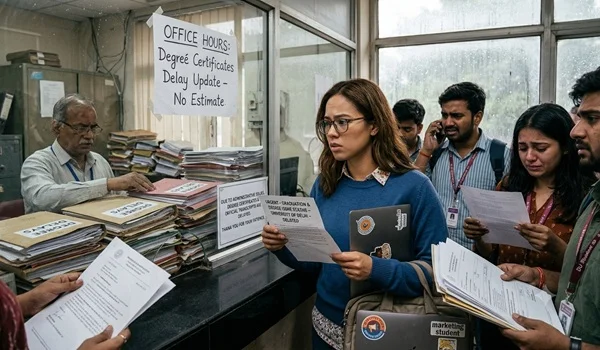
Before filing a complaint, identify the reason for the delay. Common reasons include:
- Pending examination results.
- Errors in student records.
- Unverified admission or enrolment details.
- Pending practical examinations or project assessments.
- Incomplete internship or attendance requirements.
- Administrative delays in preparing degree documents.
- Pending convocation formalities.
- Disputes regarding fees or other legitimate dues.
- Problems with the university’s examination or certificate department.
Sometimes a university has declared the final result but has not printed or dispatched the degree certificate.
In such situations, ask whether the degree has already been approved or awarded and whether the delay concerns only the physical document.
What Should You Do If Your University Does Not Issue Your Degree?
Follow these steps to create a proper record and seek a resolution.
Step 1: Confirm That You Have Completed All Requirements
First, check whether you have fulfilled every academic and administrative requirement.
Verify:
- All semester or annual examination results.
- Required credits and subjects.
- Practical examinations and project submissions.
- Internship or training requirements, if applicable.
- Attendance requirements.
- Final result or provisional result status.
- Any outstanding legitimate university dues.
If any requirement remains incomplete, request written clarification from the university.
Step 2: Contact the Examination Department
Submit a written request to the Controller of Examinations or the university’s degree certificate department.
Mention:
- Your full name.
- Enrolment or registration number.
- Course and programme.
- Year of admission.
- Year of passing.
- Final examination result details.
- Date of your degree application, if already submitted.
- Reason you need the degree certificate.
Request a clear response explaining the delay and an expected issuance date.
Always keep the acknowledgement or email confirmation.
Step 3: Submit a Formal Application to the Registrar
If the examination department does not respond, send a formal application to the Registrar or Vice-Chancellor.
Attach relevant documents, including:
- All semester marksheets.
- Final result.
- Provisional certificate, if issued.
- Identity proof.
- University registration details.
- Fee receipts.
- Previous correspondence.
- Degree application acknowledgement.
Clearly request the university to issue your degree certificate or provide a written explanation for withholding it.
Step 4: Request a Provisional Degree Certificate
If you urgently need proof of qualification for employment or higher education, ask the university to issue a provisional degree certificate.
A provisional certificate can help demonstrate that you have completed the programme, subject to the wording and validity of the document.
However, it is not necessarily a substitute for a final degree certificate wherever an employer, university or regulatory authority specifically requires the original degree.
Step 5: Send a Legal Notice if the Delay Continues
If the university continues to ignore your requests without a reasonable explanation, consult a lawyer about sending a legal notice.
The notice should mention:
- Your admission and enrolment details.
- Completion of academic requirements.
- Date of declaration of the final result.
- Previous requests for the degree.
- Applicable UGC requirements.
- The inconvenience or loss caused by the delay.
- A request for issuance within a reasonable period.
A legal notice creates a formal record of your demand and may encourage the university to resolve the matter.
Can You File a Complaint Against the University With UGC?
Yes. If your university is covered by the relevant UGC framework and has failed to resolve your complaint, you can approach the University Grants Commission through its official grievance mechanism.
The UGC provides an online platform called e-Samadhan for student grievances.
Official website: https://samadhaan.ugc.ac.in/
You can use the portal to:
- Register a student grievance.
- Explain the delay in issuing your degree.
- Upload supporting documents.
- Obtain a grievance reference number.
- Track the complaint.
- Follow up with the concerned authority.
According to the portal, student grievances have a stated maximum response time of 20 working days. This is a grievance-response timeline, not a guarantee that every degree will be physically issued within that period. <Cite refs={[“turn189846search1″,”turn189846search3”]}/>
Documents to Attach to Your UGC Complaint
| Document | Why it is useful |
| Final marksheet | Establishes academic completion |
| Provisional certificate | Supports qualification status |
| Enrolment details | Identifies the student |
| Degree application receipt | Establishes the application date |
| Fee payment receipts | Shows payment of applicable fees |
| Emails to the university | Demonstrates previous attempts |
| University replies | Helps establish the reason for delay |
| Legal notice, if any | Provides additional complaint history |
Write the complaint in clear language and explain exactly what action you expect from the university.
Can You Approach the Student Grievance Redressal Committee?
Yes. The UGC (Redressal of Grievances of Students) Regulations, 2023 provide a grievance mechanism for eligible students in higher education institutions.
Universities and covered institutions are required to maintain a Students’ Grievance Redressal Committee (SGRC) and appoint an Ombudsperson under the applicable framework.
If the university does not resolve your degree-related complaint through its normal administrative process, you can submit a grievance through the institutional mechanism.
The general procedure is:
- Submit a complaint through the university’s student grievance portal or designated channel.
- Attach your academic records and previous correspondence.
- Request the SGRC to examine the delay.
- Attend the hearing if required.
- If the grievance remains unresolved, consider approaching the Ombudsperson through the prescribed appeal procedure.
The 2023 Regulations provide for the Ombudsperson to make efforts to resolve appeals within 30 days of receipt.
Can You File a Case Against a University for Not Issuing Your Degree?
Yes, depending on the circumstances, you may have legal remedies.
1. Writ Petition Before the High Court
If a public university or statutory authority fails to perform a legal duty or acts arbitrarily, an affected student may consider approaching the jurisdictional High Court under Article 226 of the Constitution of India.
A writ of mandamus may be sought where the legal requirements are satisfied.
For example, if you have completed the course, fulfilled all requirements and the university refuses to issue your degree without a valid reason, a lawyer can assess whether a writ petition is appropriate.
2. Civil Legal Proceedings
Depending on the nature of the dispute and the university’s legal status, other civil remedies may be considered.
However, the appropriate proceeding depends on the legal duty involved, the governing university statute and the relief requested.
3. Consumer Complaint
Do not assume that every university-related dispute automatically qualifies as a consumer complaint. The availability of a consumer remedy depends on the nature of the service and applicable judicial decisions.
A student should examine the relevant legal position before choosing this route rather than relying on the Consumer Protection Act as the default remedy.
What If the University Is Withholding Your Degree Because of Pending Fees?
A university may have legitimate fee-related claims, but it should explain the contractual, statutory or regulatory basis for withholding the degree.
Ask for:
- A detailed statement of outstanding dues.
- The applicable fee rule or university regulation.
- An explanation of any disputed charges.
- A written decision on your degree application.
If the university is demanding an amount that you believe is unauthorised, challenge the demand through the university grievance mechanism and the appropriate legal forum.
Do not assume that every demand for payment is unlawful or that every outstanding amount automatically permits withholding a degree.
What If You Need Your Degree Certificate Urgently for a Job?
If an employer has given you a deadline to submit your degree, take immediate action.
You should:
- Request an urgent degree certificate from the Registrar.
- Apply for a provisional certificate.
- Obtain a final marksheet or official result document.
- Ask the university for a written confirmation of degree eligibility.
- Inform the employer about the delay.
- Provide the university’s application acknowledgement.
Some employers accept provisional certificates temporarily, while others insist on the final degree. Obtain confirmation from the employer before relying on an alternative document.
Frequently Asked Questions (FAQs)
How long can a university take to issue a degree certificate in India?
Regulation 4.4 of the UGC (Grant of Degrees and Other Awards by Universities) Regulations, 2008 provides for degree award dates within 180 days from the date students are expected to qualify and become eligible. The university’s applicable rules and academic circumstances should also be examined.
Can I complain to UGC if my university does not issue my degree?
Yes. You can register an eligible student grievance through the UGC e-Samadhan portal and submit supporting academic documents and previous correspondence.
Can a university refuse to issue my degree because of unpaid fees?
The university should explain the legal and regulatory basis for withholding the degree. If you dispute the amount or the withholding, you can challenge the decision through the university’s grievance mechanism and appropriate legal remedies.
Can I use a provisional certificate instead of a degree certificate?
A provisional certificate can serve as temporary proof of qualification if the receiving employer or institution accepts it. It may not replace the final degree wherever that document is specifically required.
Can I approach the High Court if my university refuses to issue my degree?
In appropriate cases, a student may approach the High Court under Article 226 of the Constitution. Whether a writ petition is maintainable depends on the university’s status, the legal duty involved and the facts of the dispute.
Conclusion
If your university has not issued your degree certificate despite your successful completion of the course, begin by contacting the examination department and Registrar in writing. Collect your marksheets, provisional certificate, payment receipts and previous correspondence.
If the university does not resolve the issue, approach its Student Grievance Redressal Committee and consider filing a complaint through UGC e-Samadhan. Where an unreasonable refusal continues, legal remedies, including a possible writ petition, may be available.
Do not allow an unexplained administrative delay to continue indefinitely. Maintain written records and seek a formal response from the university.
Disclaimer: This article is for general educational purposes and does not constitute legal advice. The applicable remedies depend on the university’s legal status, governing regulations, academic records and circumstances of the delay.