

An incorrect name or date of birth in a court order can create serious problems. It may affect identity verification, property transactions, inheritance, passport applications, government records, employment verification and the enforcement of a court’s decision.
For example, a court may accidentally mention the wrong spelling of a person’s name, enter an incorrect date of birth or use another person’s details in an order. Such errors should be addressed promptly because the incorrect information may appear in certified copies and official records.
In India, the appropriate remedy depends on whether the mistake is merely clerical or whether it affects a fact or finding actually decided by the court.
Can You Get an Incorrect Name or Date of Birth Corrected in a Court Order?
Yes. A court can correct certain mistakes in its judgment, decree or order.
If the court intended to record your correct name or date of birth but entered different details because of a typing, copying or clerical error, you can generally apply to the same court for correction.
Examples include:
- Your name is written as “Rahul Kumar” instead of “Rahul Kumarr”.
- Your date of birth is recorded as 15 March 1990 instead of 15 March 1991.
- Your father’s or mother’s name contains a typing mistake.
- Your name is incorrectly mentioned in the operative portion of an order.
- A correct name in the judgment is incorrectly reproduced in the decree.
However, if the court deliberately decided a disputed question about your identity or date of birth based on the evidence presented, the matter may require a review or appeal rather than a simple correction application.
Which Law Allows Correction of an Incorrect Court Order?
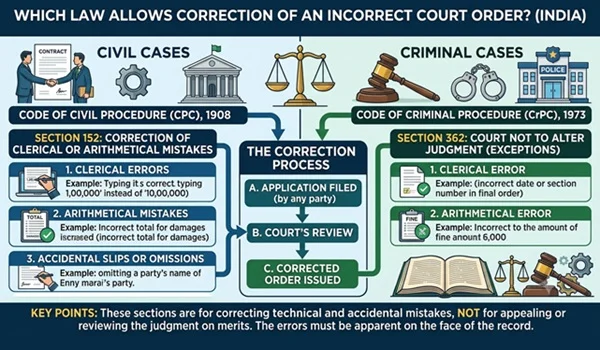
The applicable provision depends on the type of case.
Section 152 of the Code of Civil Procedure, 1908
For civil proceedings, Section 152 CPC allows a court to correct clerical or arithmetical mistakes in judgments, decrees and orders, as well as errors arising from accidental slips or omissions.
An application can be made by any party to the proceedings, and the court can also correct such mistakes on its own.
The provision allows correction at any time. Therefore, a genuine clerical error does not automatically become uncorrectable merely because considerable time has passed.
For example, if the judgment and evidence consistently show your correct date of birth as 10 January 1985, but the final order accidentally records it as 10 January 1986, you may request correction under Section 152 CPC.
Section 153 CPC
Section 153 gives courts general power to amend defects or errors in proceedings in a suit where necessary to determine the real question or issue involved.
Whether it applies to a particular mistake depends on the nature and stage of the proceedings. Section 152 remains the specific provision for clerical errors in judgments, decrees and orders.
Section 403 of the Bharatiya Nagarik Suraksha Sanhita, 2023
For criminal proceedings governed by the BNSS, Section 403 restricts a court from altering or reviewing a signed judgment or final order disposing of a case, except to correct a clerical or arithmetical error, unless another applicable law provides otherwise.
For proceedings governed by the earlier Code of Criminal Procedure, 1973, the corresponding provision was Section 362 CrPC. The applicable law may depend on the date and transitional circumstances of the case.
What Is the Difference Between a Clerical Error and a Substantive Error?
This distinction is important because courts cannot use a correction application to reopen a decision on its merits.
| Clerical or accidental error | Substantive error |
| Typing mistake in a person’s name | Court decides that a different person is the legal claimant |
| Incorrect digit in a date of birth entered accidentally | Court accepts a disputed date of birth after considering evidence |
| Name incorrectly copied into the decree | Court intentionally records a different identity |
| Accidental omission of a word | Changing a finding that affects legal rights |
A correction under Section 152 CPC is generally appropriate when the requested change reflects what the court had already intended to record.
If the requested change would alter the court’s decision, reconsider evidence or grant relief that was not originally granted, a review or appeal may be necessary.
How to Apply for Correction of an Incorrect Name or Date of Birth
Follow these steps to request correction.
Step 1: Obtain a Certified Copy of the Court Order
Obtain a certified copy of the judgment, decree or order containing the incorrect information.
Carefully identify:
- The page containing the mistake.
- The paragraph or relevant portion.
- The incorrect name or date of birth.
- The correct information that should appear.
If the judgment and decree contain different details, obtain copies of both.
Step 2: Collect Documents Supporting the Correct Information
Prepare documentary evidence establishing the correct spelling of your name or date of birth.
Depending on the case, supporting documents may include:
- Birth certificate issued by the competent authority.
- Passport.
- Aadhaar card.
- PAN card.
- School leaving certificate.
- Matriculation certificate.
- Government identity documents.
- Previous court orders containing the correct details.
Use documents that are relevant to the issue. A document showing your identity does not automatically prove that the court made a clerical mistake; you must also explain how the incorrect entry occurred.
Step 3: Prepare a Correction Application
If the error is clerical, prepare an application before the court that passed the order.
For a civil case, the application may refer to Section 152 CPC. For a criminal case governed by the BNSS, it may refer to Section 403 BNSS.
Mention the following:
- Court name and case number.
- Names of the parties.
- Date of the judgment or order.
- Exact incorrect information.
- Correct name or date of birth.
- Explanation of how the error occurred.
- Legal provision under which correction is requested.
- Documents supporting the requested correction.
- Specific relief sought.
The application should clearly state that you are seeking correction of an accidental or clerical error, not a reconsideration of the court’s decision.
Step 4: File the Application in the Same Court
Generally, approach the court that passed the judgment, decree or order.
File the application through the court registry or filing counter according to its procedural requirements. Attach the relevant documents and copies as required.
The court may issue notice to the other party if necessary and may ask for clarification or additional evidence.
Step 5: Attend the Hearing
During the hearing, explain:
- Where the incorrect information appears.
- What the correct information is.
- Why the error is clerical or accidental.
- How the supporting documents establish the correct details.
- Why the correction will not change the original decision.
If the court is satisfied, it may pass an order correcting the mistake.
Step 6: Obtain the Corrected Order or Decree
After the correction application is allowed, apply for a certified copy of the corrected order or decree.
Check that the correction has been incorporated properly. If the original decree or official record also needs amendment, follow the court registry’s directions to ensure the correction is reflected in the relevant record.
What If the Court Rejects Your Correction Application?
If the court rejects the application, first examine the reason for rejection.
- If the court considers the mistake substantive: You may need to pursue a review or appeal, depending on the nature of the order and the applicable law.
- If the court misunderstood the supporting documents: Your lawyer can assess whether further proceedings or an appropriate challenge are available.
- If the court has made a decision on a disputed identity or date of birth: You may need to challenge that finding rather than seek a clerical correction.
A review application is not a substitute for an appeal. The available remedy and limitation period depend on the court, type of case and applicable statute.
What Is the Time Limit for Correcting an Incorrect Court Order?
For civil cases, Section 152 CPC expressly permits correction of qualifying clerical or accidental errors “at any time”. It does not prescribe a fixed filing deadline.
However, this does not mean every challenge can be filed without a time limit. If the error is substantive and you need to file a review or appeal, the relevant limitation period applies.
For criminal cases, Section 403 BNSS permits correction of clerical or arithmetical errors in a signed judgment or final order, but does not provide a general right to reopen the decision.
It is advisable to act promptly, particularly where the incorrect details are affecting an ongoing legal proceeding, government record or transaction.
Important Supreme Court Judgment on Correction of Court Orders
In Jayalakshmi Coelho v. Oswald Joseph Coelho (2001), the Supreme Court explained the limits of Section 152 CPC.
The Court held that the provision can be used to correct an accidental mistake or omission reflecting what the court originally intended. It cannot be used to reconsider the merits of a case or introduce terms that the court never intended to include in its decree.
This principle is important when seeking correction of a person’s name or date of birth. The applicant must establish that the incorrect entry is genuinely a clerical or accidental error, rather than an attempt to change a finding already made by the court.
Documents Required for a Court Order Correction Application
The exact documents depend on the case, but the following may be useful:
| Document | Purpose |
| Certified copy of the judgment or order | Identifies the incorrect entry |
| Copy of the decree, if applicable | Helps establish whether the mistake also appears in the decree |
| Birth certificate | Supports the correct date of birth |
| Passport or government identity document | Supports identity details |
| School or matriculation certificate | May support date-of-birth information |
| Relevant pleadings or application | Shows what information was originally presented |
| Supporting affidavit | Explains the error and requested correction |
The court may require additional documents or notice to the other party.
Frequently Asked Questions (FAQs)
Can I correct my name in a court order after the case is completed?
Yes, if the incorrect name is a clerical mistake or an accidental error. In a civil case, you can generally apply under Section 152 CPC to the court that passed the order.
Can a court correct my date of birth after issuing the final judgment?
Yes, where the incorrect date was entered due to a clerical or accidental mistake. However, if the court deliberately decided a disputed date of birth, a correction application may not be sufficient.
Can I correct an incorrect name in a divorce decree?
If the name was accidentally misspelled or incorrectly typed, you may request correction from the family court. The court will examine whether the requested change is clerical or would alter the substance of the decree.
Can I apply for correction without hiring a lawyer?
You may be able to file an application yourself, subject to the applicable court procedure. However, legal assistance is advisable if the mistake affects identity, property rights, inheritance, criminal proceedings or the final outcome of the case.
Can a court change a signed criminal judgment to correct my date of birth?
Section 403 of the BNSS allows correction of clerical or arithmetical errors in a signed judgment or final order. It does not generally permit the court to review or reconsider its decision.
Conclusion
If your name or date of birth is incorrectly mentioned in a court order, identify whether the mistake is clerical or substantive before choosing a legal remedy. For a genuine clerical mistake in a civil judgment, decree or order, Section 152 CPC provides a mechanism to seek correction from the same court. In criminal proceedings governed by the BNSS, Section 403 addresses correction of clerical or arithmetical errors.
Collect the relevant documents, obtain a certified copy of the order and submit a properly supported application. If the incorrect information reflects a judicial finding rather than a typing mistake, consult a lawyer about review or appeal instead.
Disclaimer: This article is for general educational purposes and is not legal advice. The appropriate remedy depends on the type of case, the court that passed the order and the nature of the error.