

Heavy rain, storms, cyclones and falling trees can cause significant damage to houses, vehicles, commercial buildings and agricultural property. Repairing a damaged roof, replacing household equipment or fixing a car can create unexpected financial pressure.
If you have an appropriate insurance policy, you may be able to recover some or all of the eligible repair or replacement costs.
For example, suppose a large tree falls on your house during a storm and damages the roof, windows and furniture. You may be able to submit a home insurance claim if the incident falls within the insured events covered by your policy.
Similarly, if heavy rain floods your parked car, a comprehensive motor insurance policy may cover the resulting damage, subject to its terms and exclusions.
This article explains how to claim insurance for damage caused by falling trees or heavy rain in India, which policies may provide coverage, what documents are required and how to handle claim rejection or delays.
Which Insurance Policies Cover Damage Caused by Falling Trees or Heavy Rain?
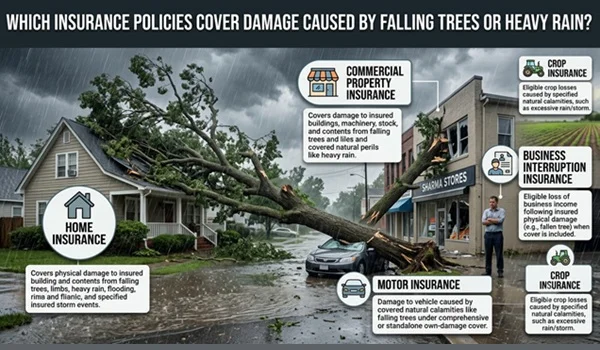
The first step is to identify the insurance policy that covers the damaged property.
Different policies provide different types of protection.
| Type of insurance | Possible coverage |
| Home insurance | Storm, flood, inundation and other specified insured events affecting the insured building or contents |
| Motor insurance | Accidental damage caused by covered natural calamities under comprehensive or standalone own-damage cover |
| Commercial property insurance | Damage to insured buildings, machinery, stock and contents from covered natural perils |
| Crop insurance | Eligible crop losses caused by specified natural calamities under the applicable scheme |
| Business interruption insurance | Eligible loss of business income following insured physical damage, if the required cover is included |
The actual coverage depends on the policy schedule, wording, exclusions and selected add-ons.
For example, HDFC ERGO’s Standard Fire and Special Perils Policy lists storm, cyclone, flood and inundation among the covered events. New India Assurance’s Householder Policy also lists several natural calamity-related perils.
Does Home Insurance Cover Damage Caused by a Falling Tree?
A falling tree can damage different parts of a residential property, including:
- Roof and ceiling.
- Boundary walls.
- Windows and doors.
- Water tanks.
- Electrical installations.
- Furniture and household appliances.
- Other insured contents.
Whether the insurer pays depends on the circumstances and policy wording.
For example, if a healthy tree falls on your house during a covered cyclone or storm, the resulting physical damage may qualify for a claim under the relevant insured peril.
However, if a tree falls because of gradual deterioration, poor maintenance or an excluded cause, the insurer may dispute the claim.
Also, do not assume that every home insurance policy automatically covers the cost of removing fallen trees. Debris removal, landscaping and other associated expenses may have separate limits or exclusions.
What if heavy rain damages your house?
Heavy rain can cause several types of property damage:
- Roof leakage.
- Flooding inside the house.
- Damage to walls and flooring.
- Water entering electrical installations.
- Damage to insured furniture and appliances.
- Damage caused by overflowing drains or water entering the premises.
Flood and inundation coverage may apply under the relevant home insurance wording.
However, ordinary seepage, gradual dampness, defective waterproofing and maintenance-related leakage may be excluded or treated differently.
Check whether the damage resulted from a covered sudden event or an excluded maintenance problem.
Does Motor Insurance Cover a Car Damaged by a Falling Tree or Heavy Rain?
If a tree falls on your parked car or heavy rain causes flooding, your motor insurance policy may cover the resulting damage.
However, you generally need a comprehensive motor insurance policy or standalone own-damage cover.
Comprehensive motor insurance
A comprehensive motor insurance policy generally covers:
- Accidental damage to your vehicle.
- Damage caused by covered storms and cyclones.
- Flood and inundation damage.
- Certain natural calamity-related losses.
- Third-party liability, as required by law.
For example, if a tree falls on your parked car during a storm and damages the roof and windscreen, you can report the incident to your insurer under the own-damage section.
Third-party insurance
A third-party-only motor insurance policy does not normally pay for damage to your own vehicle.
It primarily covers eligible third-party liability arising from the use of the insured vehicle.
Therefore, if your car is damaged by a falling tree or flood, a third-party-only policy generally will not provide compensation for your vehicle’s repair costs.
Important precaution
Never start a car or motorcycle that has been submerged in floodwater without professional inspection.
Water entering the engine or electrical systems can cause additional damage. Inform the insurer and follow its instructions before attempting repairs.
Does Commercial Property Insurance Cover Damage from Heavy Rain or Falling Trees?
Businesses may suffer substantial losses when storms, heavy rain or falling trees damage commercial premises.
Possible damage includes:
- Factory roofs.
- Office buildings.
- Warehouses.
- Machinery and equipment.
- Furniture and computers.
- Raw materials.
- Finished goods and inventory.
- Electrical and other installations.
A Standard Fire and Special Perils policy may cover physical damage to insured business property caused by specified natural calamities.
However, the business must check whether the damaged property and the relevant risk are included in its policy.
For example, HDFC ERGO’s Standard Fire and Special Perils information identifies insured property such as buildings, machinery, furniture and stocks, subject to policy terms.
What about business interruption losses?
Suppose a warehouse is damaged by flooding and the business cannot operate for several weeks.
The business may lose income during the closure.
However, ordinary property insurance does not automatically compensate for every loss of revenue.
Business interruption or consequential loss coverage may be required. Such cover generally has specific conditions, including a connection with insured physical damage and any applicable waiting period.
Does Crop Insurance Cover Damage Caused by Heavy Rain or Falling Trees?
Farmers may be eligible for compensation under the Pradhan Mantri Fasal Bima Yojana (PMFBY) or another applicable crop insurance arrangement.
PMFBY covers specified agricultural risks, including certain losses caused by storms, floods, inundation, hailstorms and other notified events.
However, eligibility depends on the insured crop, notified area, policy period and type of loss.
For certain localised calamities and post-harvest losses, individual farm-level assessment is provided.
The PMFBY guidelines specify a 72-hour loss-intimation requirement for applicable localised and post-harvest claims.
If heavy rain or a falling tree damages your standing crop, contact the insurer or agriculture authorities immediately and check whether the particular loss qualifies under the applicable scheme.
Do not assume that every tree-related agricultural loss is automatically covered.
How to Claim Insurance for Damage Caused by a Falling Tree or Heavy Rain
Follow these steps after discovering the damage.
Step 1: Ensure everyone’s safety
Before dealing with insurance formalities, make sure that people are safe.
If a tree has fallen on a building, avoid entering structurally damaged areas.
If electrical wires are damaged or water has entered electrical installations, stay away and contact the appropriate emergency or utility services.
Do not attempt to remove a large tree yourself.
Step 2: Inform the insurance company immediately
Contact your insurer through its official customer service number, website, mobile application or branch.
Provide the following information:
- Policy number.
- Name of the policyholder.
- Date and approximate time of the incident.
- Location of the damaged property.
- Type of damage.
- Estimated extent of loss.
- Contact details.
Ask the insurer to register the claim and provide a claim reference number.
Do not wait until the repair work is completed before notifying the insurer.
Step 3: Take photographs and videos
Document the damage before making non-emergency repairs.
Capture:
- Fallen tree and its position.
- Damaged roof or walls.
- Broken windows and doors.
- Floodwater inside the property.
- Damaged furniture and appliances.
- Vehicle damage from different angles.
- Damaged machinery and stock.
- Surrounding conditions that explain the incident.
Take photographs from a safe distance.
Keep the original images and videos because they may help establish the circumstances and extent of the loss.
Step 4: Prevent further damage
Take reasonable steps to prevent additional loss.
For example:
- Cover an exposed roof with a temporary waterproof sheet if it is safe.
- Move undamaged furniture away from water.
- Protect movable goods and equipment.
- Arrange emergency assistance to prevent further flooding.
- Disconnect electricity through a safe procedure where necessary.
Keep receipts for reasonable emergency expenses.
Do not undertake major permanent repairs or dispose of damaged property before the insurer or surveyor has had a reasonable opportunity to inspect it, unless immediate action is necessary for safety or preventing further damage.
Step 5: Obtain a police or municipal report, if required
A police complaint is not automatically required for every storm or rain-related claim.
However, the insurer may request additional evidence in certain cases.
For example, a police report or municipal record may help establish:
- A tree falling on a vehicle.
- Damage caused by a fallen tree on a public road.
- A major accident involving property damage.
- An incident involving public infrastructure.
- A suspected deliberate act or dispute about responsibility.
If the tree belonged to a municipal authority or another property owner, preserve relevant records and photographs.
Step 6: Submit the claim form and supporting documents
Complete the insurer’s prescribed claim form and submit the requested evidence.
Ask the insurer whether documents can be uploaded online or must be submitted physically.
Keep acknowledgement of every submission.
Step 7: Cooperate with the insurance surveyor
For eligible property claims, the insurer may appoint a surveyor or loss assessor to inspect the damage.
The surveyor may examine:
- Cause of damage.
- Extent of physical loss.
- Insured property details.
- Repair or replacement estimates.
- Applicable exclusions.
- Salvage value.
- Supporting photographs and documents.
Provide accurate information and allow reasonable access for inspection.
Step 8: Obtain the claim assessment and settlement
After examining the evidence, the insurer determines the admissible claim amount according to the policy.
The amount may be affected by:
- Sum insured.
- Applicable deductible.
- Depreciation.
- Underinsurance.
- Salvage value.
- Policy exclusions.
- Limits on specific items or expenses.
If the claim is approved, the insurer may pay the admissible amount or settle it through an approved repair arrangement, depending on the policy.
Documents Required to Claim Insurance for Tree or Rain Damage
The document checklist depends on the type of insurance.
| Document | Purpose |
| Insurance policy or policy number | Establishes coverage |
| Claim form | Official claim request |
| Identity and address proof | Policyholder verification |
| Photographs and videos | Evidence of damage |
| Repair estimates | Estimated restoration costs |
| Original repair invoices | Evidence of completed repairs |
| Purchase invoices | Evidence of damaged property value |
| Bank details | Claim payment |
| Police or municipal report, if applicable | Additional incident evidence |
| Surveyor report | Loss assessment |
| Vehicle RC and driving licence, where relevant | Motor claim verification |
| Hospital or medical records, if relevant | Supporting evidence for associated personal injury claims |
For business claims, the insurer may also request stock registers, purchase invoices, accounting records and asset registers.
For crop insurance, land records, crop details, bank information and the insurance application may be required.
Submit only the documents relevant to your particular claim.
How Is the Insurance Claim Amount Calculated?
The insurer does not necessarily pay the entire amount mentioned in your repair estimate.
The admissible amount is calculated according to the insured value, policy conditions, depreciation, deductibles and other applicable adjustments.
A simplified illustration is:
Admissible Claim = Eligible Assessed Loss − Applicable Deductible − Other Policy Adjustments
Consider this example:
Suppose a tree falls on an insured house during a storm.
| Particulars | Amount |
| Estimated eligible repair cost | ₹2,00,000 |
| Surveyor-assessed eligible loss | ₹1,80,000 |
| Applicable deductible | ₹5,000 |
| Other applicable deductions | ₹10,000 |
| Illustrative claim payable | ₹1,65,000 |
The actual settlement may differ depending on the policy wording and assessment.
What if the house is underinsured?
Suppose your building is insured for ₹20 lakh, but its actual value for insurance purposes is ₹40 lakh.
If the policy contains an average clause, the insurer may proportionately reduce the claim.
The precise calculation depends on the policy and applicable valuation provisions.
Common Reasons Why Insurance Claims for Heavy Rain or Falling Trees Are Rejected
Even if a property is damaged during bad weather, the insurer may reject the claim if the loss is not covered.
Common reasons include:
- The policy does not cover the relevant risk
A policy may not include the specific natural peril or property involved.
- Only third-party motor insurance is available
A third-party-only policy generally does not cover damage to the insured vehicle.
- Damage results from poor maintenance
Gradual deterioration, seepage, defective waterproofing and neglected maintenance may be excluded.
- The damaged property is not insured
For example, an insurance policy may cover the building but not certain household contents, or vice versa.
- Late claim notification
The policy may require prompt intimation. Delays can create difficulties in verifying the circumstances and may affect claim assessment.
- Repairs were completed before inspection
If the insurer cannot verify the original damage because important evidence was removed or repaired, the claim may become difficult to assess.
- The loss exceeds policy limits
Certain items or expenses may have sub-limits, deductibles or specific coverage restrictions.
- The damage is outside the policy period
Insurance generally covers eligible incidents occurring during the period of coverage, not losses that occurred before the policy started or after it expired.
What If the Insurance Company Rejects or Delays Your Claim?
If your claim is rejected, request a written decision explaining the reason.
Check whether the insurer has correctly considered:
- The insured event.
- The policy schedule.
- Applicable exclusions.
- Surveyor findings.
- Supporting documents.
- Deductibles and coverage limits.
If you disagree with the decision, follow these steps.
Step 1: File a complaint with the insurer
Contact its grievance redressal officer and submit the claim reference number, rejection letter, photographs, invoices and your explanation.
Step 2: Escalate to IRDAI
If the insurer does not resolve your complaint satisfactorily, use the Bima Bharosa grievance portal:
https://bimabharosa.irdai.gov.in/
Step 3: Approach the Insurance Ombudsman
If the dispute meets the eligibility requirements under the Insurance Ombudsman Rules, you may approach the appropriate Ombudsman.
This can be relevant when a claim is unfairly rejected, delayed or settled for an amount disputed by the policyholder.
Precautions to Take Before and After Heavy Rain
Although natural disasters cannot always be prevented, some precautions can reduce property damage and make insurance claims easier.
- Keep large trees near buildings inspected and properly maintained.
- Remove visibly dangerous branches through qualified professionals.
- Maintain roof drainage and gutters.
- Check waterproofing and roof condition.
- Keep important electrical equipment away from flood-prone areas.
- Park vehicles away from visibly unstable trees during severe weather.
- Maintain an updated list of insured household or business assets.
- Keep purchase invoices and policy documents safely.
- Review your insurance coverage and sum insured periodically.
- Save the insurer’s emergency claim contact details.
Remember that taking reasonable preventive measures does not guarantee that a claim will be paid, but it can help reduce damage and support the claim assessment.
Frequently Asked Questions (FAQs)
Does home insurance cover a tree falling on a house?
It may cover the resulting damage if the incident falls within an insured peril, such as a covered storm or cyclone, and is not excluded. Check the policy wording because falling-tree damage and tree-removal expenses may be treated differently.
Can I claim car insurance if a tree falls on my parked car?
Generally, yes, if you have a comprehensive or standalone own-damage motor policy that covers the incident. A third-party-only policy generally does not pay for damage to your own car.
Does insurance cover damage caused by heavy rain entering my house?
It may be covered if the damage results from an insured event such as flood or inundation. Gradual seepage, defective waterproofing and maintenance-related leakage may not be covered.
Do I need an FIR to claim insurance for a fallen tree?
Not necessarily. An FIR is not a universal requirement for every weather-related insurance claim. However, the insurer may request a police or municipal report depending on the circumstances.
Can I remove a fallen tree before the insurance surveyor arrives?
You should not undertake major removal or repairs before documenting the damage and informing the insurer. However, immediate action may be necessary to protect people and prevent further loss. Photograph the scene first if safe, keep records of emergency work and inform the insurer.
Will insurance pay for removing a fallen tree?
Not automatically. Tree removal, debris disposal and related expenses may have separate limits or exclusions. Check the policy schedule and wording.
Can I claim insurance for furniture damaged by rainwater?
You may be able to claim if household contents are insured and the damage results from a covered event. If your policy covers only the building, furniture and other contents may not be included.
What if a tree from my neighbour’s property falls on my house?
First, notify your insurer and document the damage. Depending on the circumstances, questions of the neighbour’s responsibility may also arise. The insurer may examine whether the tree fell because of a storm or another cause and whether negligence contributed to the incident.
How quickly should I report heavy rain or falling-tree damage?
Inform your insurer as soon as possible and follow the notification period in your policy. For eligible localised and post-harvest crop insurance claims under PMFBY, the prescribed intimation period is generally 72 hours.
Conclusion
Damage caused by falling trees or heavy rain can create significant financial losses, but an appropriate insurance policy may help you recover eligible repair and replacement expenses.
Start by identifying the policy that covers the damaged property, whether it is a house, vehicle, commercial building or crop. Inform the insurer promptly, photograph the damage, take reasonable steps to prevent further loss and submit the required documents.
Most importantly, check the policy wording rather than assuming that every form of rainwater damage, fallen-tree damage or debris removal is covered.
If the insurer rejects or delays your claim, request a written explanation and use the formal grievance process.
Disclaimer: This article is for educational purposes only and does not constitute insurance or legal advice. Claim eligibility, settlement amounts, exclusions and document requirements depend on the specific insurance policy and circumstances of the incident.