

After purchasing a flat, house or commercial property in India, one important task is transferring the existing electricity and water connections into your name. Although the sale deed establishes the property transaction, utility records may continue to show the previous owner’s name until the relevant electricity distribution company and water authority update their records.
If you ignore this process, you may face problems with billing, outstanding dues, service complaints and future property transactions. The transfer also helps establish a clear record of who is responsible for utility consumption after possession.
The good news is that most electricity and water authorities provide a name-change or connection-transfer procedure. Here is how to complete it, which documents you need and what to do if the previous owner does not cooperate.
Why Should You Transfer Electricity and Water Connections After Buying a Property?
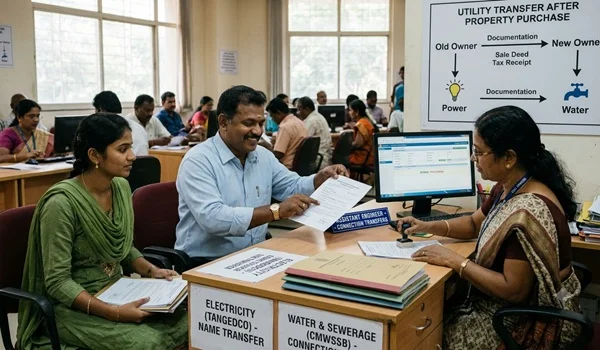
When you purchase a resale property, the existing electricity meter and water connection may remain registered in the seller’s name.
Transferring these connections helps you:
- Receive electricity and water bills in your own name.
- Maintain a clear record of utility consumption.
- Avoid confusion about previous and current outstanding dues.
- Submit utility bills as supporting address documents where accepted.
- Raise complaints directly with the relevant service provider.
- Avoid difficulties when selling or renting out the property later.
Remember that transferring a utility connection does not establish legal ownership of the property. Your registered sale deed or other valid ownership document remains the primary evidence of ownership.
Documents Required to Transfer Electricity and Water Connections
The required documents vary by state, electricity distribution company and water authority. However, buyers should generally prepare the following:
| Document | Why it is required |
| Registered sale deed | Proof of property ownership |
| Identity proof | Verifies the new applicant |
| Address proof | Confirms applicant details |
| Latest electricity bill | Identifies the existing electricity connection |
| Latest water bill | Identifies the existing water connection |
| Latest payment receipts | Helps establish payment status |
| Possession letter | Supports possession details, if required |
| Previous owner’s NOC | May be required for certain transfers or security deposit claims |
| Passport-size photograph | Required by some service providers |
| Affidavit or undertaking | Required in certain cases |
| Property or consumer identification number | Helps locate the existing connection |
For jointly owned properties, the electricity company or water authority may also ask for an NOC from other co-owners, depending on the circumstances.
Keep scanned copies of all documents so that you can submit applications online where the facility is available.
How to Transfer an Electricity Connection After Buying a Property
Electricity connection transfer is generally known as a change of consumer name, ownership transfer or name mutation.
The procedure is handled by the distribution company (DISCOM) supplying electricity to the property.
Step 1: Identify Your Electricity Distribution Company
Check the latest electricity bill to identify the DISCOM.
For example:
- Delhi: BSES Rajdhani, BSES Yamuna or Tata Power Delhi Distribution.
- Uttar Pradesh: The relevant DISCOM under the state distribution system.
- Maharashtra: Maharashtra State Electricity Distribution Company Limited (MSEDCL) or the applicable private distribution licensee.
- Karnataka: The relevant electricity supply company (ESCOM).
- Gujarat: The applicable state or private distribution company.
Do not submit the application to a different electricity company simply because it operates in the same city.
Step 2: Check Outstanding Electricity Dues
Obtain the latest bill and check whether any electricity charges, late payment surcharges or other recoverable amounts are pending.
If the seller has unpaid bills, ask for clarification before completing the transfer.
Check the sale agreement to understand who is responsible for electricity dues relating to the period before possession.
Get a final meter reading on the possession date, where possible, and preserve the corresponding bill or photograph.
Step 3: Submit the Name-Change Application
Visit the DISCOM’s official website or customer service centre.
Look for services such as:
- Change of consumer name.
- Transfer of electricity connection.
- Change of ownership.
- Consumer details modification.
Enter the existing consumer number, property address and new owner’s details.
Upload the required ownership and identity documents. Pay any applicable processing fee or security deposit through an authorised payment channel.
Step 4: Obtain an Application Acknowledgement
After submitting the application, save:
- Application reference number.
- Payment receipt.
- Uploaded document list.
- Submission date.
- Any deficiency notice.
If the DISCOM requests additional documents, submit them within the prescribed period.
Step 5: Verify the Updated Electricity Bill
Once the request is approved, check the next bill to confirm that:
- Your name appears correctly.
- The consumer number remains correctly associated with the property.
- The meter reading is accurate.
- The sanctioned load and tariff category are correct.
- Previous payment adjustments have been recorded.
Do not assume that the name has changed simply because the application has been submitted.
How to Transfer a Water Connection After Buying a Property
The water connection transfer process is usually called water connection mutation or change of name.
The application is submitted to the local water supply authority or municipal water department.
Step 1: Identify the Water Supply Authority
Depending on the property location, the water connection may be managed by:
- State water supply department.
- Municipal corporation.
- Jal Board.
- Municipal council.
- Local development authority.
- Other authorised water utility.
For example, Delhi Jal Board (DJB) manages water and sewerage services in areas under its jurisdiction.
Step 2: Obtain the Latest Water Bill
Collect the latest water bill and note the following details:
- KNO or water connection number, where applicable.
- Existing consumer’s name.
- Property address.
- Meter details, if applicable.
- Outstanding water charges.
- Previous payment information.
Check whether the water connection is individual or part of a bulk supply arrangement managed by a housing society.
In some apartment complexes, individual flat owners do not have separate municipal water connections. Instead, the society or apartment association manages the bulk connection and collects water charges from residents.
Step 3: Prepare Ownership Documents
Prepare the registered sale deed, identity proof, latest paid water bill and any additional documents requested by the authority.
Some water authorities also require an affidavit or undertaking confirming that there is no ownership dispute or court order affecting the property or connection.
Step 4: Submit the Mutation Application
Apply online through the official water authority portal or submit the prescribed form to the relevant office.
Provide the existing connection number and new owner’s details.
Upload the documents and pay the applicable mutation or transfer charges.
Step 5: Check the Application Status
Save the application number and track the request.
The water authority may approve the application, request additional documents or ask you to resolve outstanding dues.
After approval, verify that the next water bill displays the new owner’s name.
Delhi-Specific Procedure for Electricity and Water Connection Transfer
Homebuyers in Delhi may need to deal with two different authorities: the electricity distribution company and Delhi Jal Board.
Electricity Connection Transfer in Delhi
The electricity connection is handled by the relevant DISCOM.
For example:
| Electricity provider | Official website |
| BSES Rajdhani Power Limited | https://www.bsesdelhi.com/ |
| BSES Yamuna Power Limited | https://www.bsesdelhi.com/ |
| Tata Power Delhi Distribution Limited | https://www.tatapower-ddl.com/ |
The general procedure is to use the connection services or change-request section and submit the ownership and identity documents.
Under the Delhi Electricity Regulatory Commission’s Supply Code, the name-change process has provisions concerning ownership transfer, outstanding dues and completion within two billing cycles after acceptance of the application or clearance of dues, whichever is later.
A 2026 announcement also described an automatic transfer mechanism using property registration information. Buyers should verify whether the relevant DISCOM has implemented the applicable arrangement for their transaction rather than assuming that registration alone has updated the electricity account.
Water Connection Transfer Through Delhi Jal Board
Delhi Jal Board provides an online mutation facility for changing the name of the water connection holder.
Official website: https://delhijalboard.delhi.gov.in/
The general procedure is:
- Visit the DJB website.
- Open the customer or water connection services section.
- Select the mutation application.
- Enter the existing water connection details.
- Provide the new owner’s information.
- Upload the sale deed and other required documents.
- Pay the mutation charges after approval, as instructed.
- Track the application and verify the updated record.
DJB’s published FAQ lists identity proof, ownership proof, the latest water bill and an undertaking concerning legal disputes among the required documents. Its website also provides a downloadable mutation application form.
DJB’s published water-service information specifies a mutation service timeline of 15 days. However, the actual application should be checked for document deficiencies and current processing requirements.
What If the Previous Owner Refuses to Provide an NOC?
Sometimes the previous owner is unavailable, refuses to cooperate or does not provide a No Objection Certificate.
This does not necessarily mean that the buyer cannot transfer the utility connection.
Take the following steps:
- Check whether the registered sale deed is sufficient proof of ownership.
- Ask the utility provider whether an NOC is mandatory for the particular transfer.
- Submit the latest paid bill and other available ownership documents.
- Request written clarification if the application is rejected for want of an NOC.
- Consult a property lawyer if the authority refuses to process a valid ownership-based application.
The NOC requirement can differ depending on whether the buyer wants only a name change or also wants the previous owner’s security deposit transferred.
For example, some electricity regulations allow a new consumer to apply without the previous consumer’s NOC, subject to payment of a fresh security deposit and the applicable conditions.
Never submit a forged NOC or a document signed without the previous owner’s authority.
What Happens If the Previous Owner Has Unpaid Electricity or Water Bills?
This is one of the most important issues to check before purchasing a resale property.
Suppose you purchase a flat in October, but the seller has not paid electricity bills for the preceding three months.
Before completing the transfer, identify:
- The total outstanding amount.
- The billing period.
- Whether late payment charges have been added.
- The final meter reading on the possession date.
- The responsibility for previous dues under the sale agreement.
Ask the seller to clear outstanding amounts relating to their ownership or occupancy period where they are responsible under the agreement and applicable law.
For electricity connections in Delhi, the Supply Code provides that the connection transfer should not be approved until recoverable dues relating to the connection are paid. It also provides that once the connection is transferred, previous arrears should not be recovered from the new consumer under that provision.
However, the treatment of old dues can differ across utilities and jurisdictions. Do not assume that every electricity or water authority follows identical rules.
For a disputed amount, obtain a written statement from the utility provider before paying.
Can You Transfer Utility Connections Without a Registered Sale Deed?
The answer depends on the type of transaction and the documents accepted by the service provider.
A registered sale deed is generally the strongest ownership document for a normal property purchase.
However, other legally recognised documents may be accepted in specific circumstances, such as:
- Conveyance deed.
- Gift deed.
- Partition deed.
- Relinquishment deed.
- Succession or legal heir documents.
- Court order.
- Registered lease or tenancy documents, where the utility allows an occupancy-based transfer.
If the property has been inherited, the utility provider may require a death certificate, succession-related documents and NOCs from other legal heirs.
If the property has multiple owners, the utility may ask for consent from the other co-owners or permit one owner to become the primary applicant subject to its rules.
A buyer should confirm the acceptable documents before submitting the application.
Common Mistakes to Avoid During Utility Connection Transfer
| Mistake | Why you should avoid it |
| Ignoring previous bills | Outstanding dues can delay transfer |
| Not recording meter readings | Can create disputes about consumption |
| Assuming sale deed updates utility records automatically | Utility records may require a separate application |
| Submitting incomplete documents | May lead to rejection or delay |
| Ignoring the connection number | Can result in an application against the wrong account |
| Paying unofficial agents | Creates a risk of fraud |
| Not checking the first updated bill | Errors may continue into future billing cycles |
| Closing the seller’s old account without verification | May complicate security deposit or final bill settlement |
Checklist Before and After Buying a Property
Use this checklist to make sure that electricity and water connections are properly transferred.
Before taking possession:
- Obtain the latest electricity bill.
- Obtain the latest water bill.
- Verify outstanding dues.
- Record the electricity meter reading.
- Record the water meter reading, where applicable.
- Obtain payment receipts from the seller.
- Record utility account and connection numbers.
- Include responsibility for previous dues in the sale documentation.
After taking possession:
- Apply for electricity name transfer.
- Apply for water connection mutation.
- Upload the registered sale deed and identity proof.
- Obtain application acknowledgement.
- Pay authorised charges.
- Track both applications.
- Verify the first bills issued after approval.
- Preserve the updated utility records.
Frequently Asked Questions (FAQs)
Is it compulsory to transfer the electricity connection after buying a flat?
The applicable electricity supply regulations and utility procedures govern the name-change requirement. It is advisable to update the consumer record promptly so that bills and service requests are linked to the new owner.
Can I transfer an electricity connection without the previous owner’s NOC?
In some jurisdictions, yes. The registered sale deed or other accepted ownership document may be sufficient. However, the previous owner’s NOC may be required for transferring the security deposit or in certain specific cases.
Can I transfer a water connection online in India?
Many water authorities provide online mutation facilities, but availability varies by city. Check the official website of the local water supply department or municipal corporation.
Will an electricity connection be disconnected if I do not transfer it immediately?
Not automatically in every case. However, unpaid bills, account disputes or other violations can lead to service-related problems. Continue paying valid bills and apply for the name change promptly.
Who is responsible for electricity and water dues before the property purchase?
The responsibility depends on the sale agreement, billing period and applicable utility regulations. Buyers should obtain the latest paid bills and settle or document previous dues before taking possession.
Can a tenant transfer an electricity or water connection into their name?
Some utilities permit a change of consumer name based on a valid tenancy or occupancy document, often with the owner’s NOC. The procedure depends on the local utility’s rules.
Conclusion
Transferring electricity and water connections after purchasing a property is an important administrative step that should not be overlooked. The buyer should identify the relevant utility providers, verify previous outstanding bills, record meter readings and submit the required ownership documents.
Electricity name transfer and water connection mutation are separate procedures, so completing one does not automatically update the other. Keep the application receipts and verify the first bills issued after approval.
Most importantly, resolve previous utility dues and document the seller’s responsibility before taking possession. This can help prevent billing disputes and make future property transactions easier.